Stone Veneer Cost in Tennessee: What Moves the Number
Two stone veneer bids on the same Murfreesboro house can differ by half. Almost always the gap sits in three places: which stone, what is behind it, and how many hours the pattern takes to set.
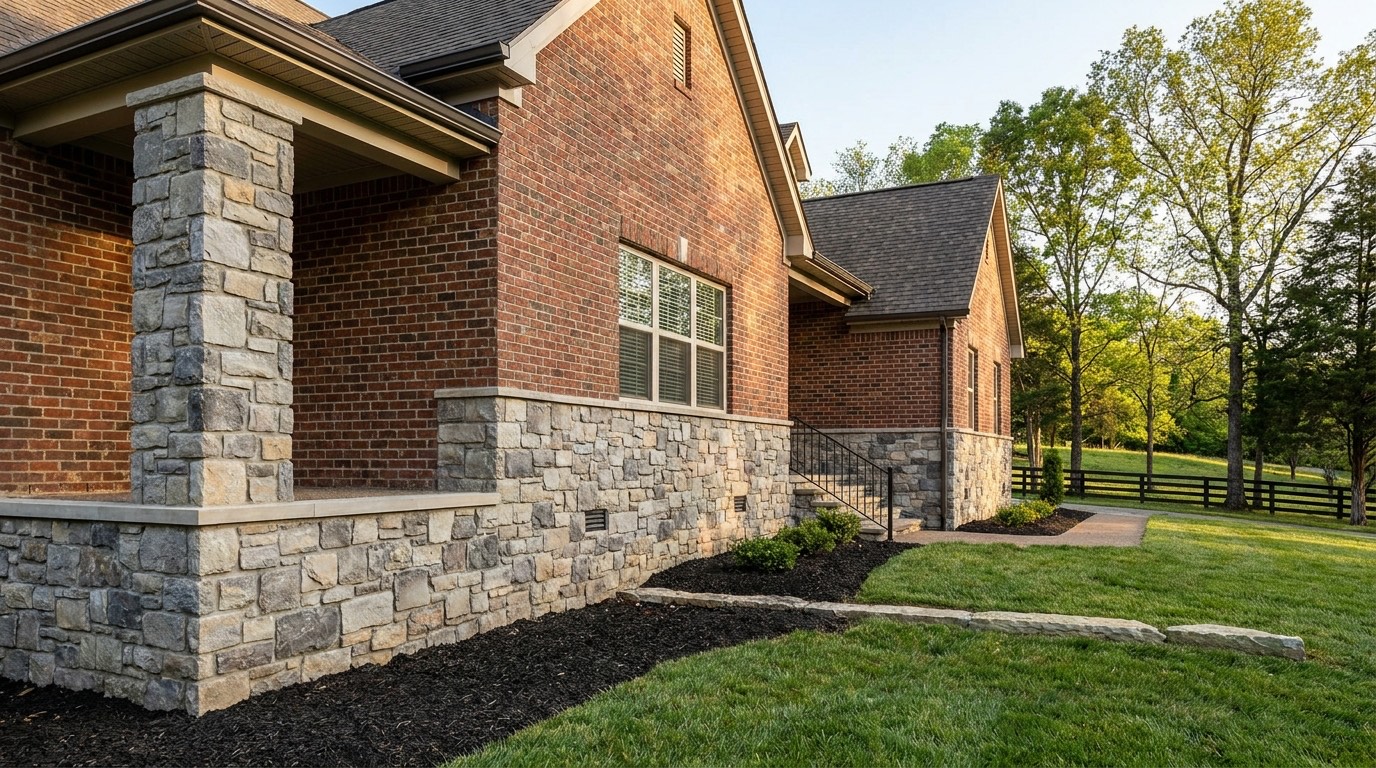
One word, two completely different products
Stone veneer means either quarried stone cut thin, or a cast concrete product molded and colored to look like it. They hang on a wall the same way. They do not cost the same, they do not weigh the same, and they do not age the same.
Manufactured stone is lighter, more uniform, and faster to set because the pieces are made to fit together. Natural stone arrives with real thickness variation, so a mason spends time sorting, cutting and shimming. That sorting time is a large share of what you pay for on a natural stone job.
Neither one is the right answer everywhere. On a full-height chimney chase where the eye is close, natural stone reads better. On a long foundation skirt that spends its life behind shrubs, manufactured stone does the same visual job for less.
The ranges, and why they are ranges
Professional stone veneer installation commonly runs $13 to $22 per square foot in national pricing. Natural thin cut veneer installed typically runs $15 to $25 per square foot, and complex or elevated work in natural stone typically runs $25 to $45. Full bed stone that needs its own supporting ledge sits above the thin cut version, because the wall underneath has to carry real weight. Those are national figures rather than Tennessee ones, and they are planning numbers, not quotes.
The spread inside each band is wide because the same square foot of wall can be easy or awful. A flat gable at ground level with a dry driveway to stage from is the cheap end. A second-story chimney with a pool deck under it is the other end, on the identical stone.
The Tennessee picture does not line up neatly with those bands. The one per square foot rate we could find published by a mason in this state sits well under the bottom of them, and nobody has explained the gap convincingly. So take the figures above as the outer frame of a conversation and not as a price. Anybody who gives you a per foot number over the phone without seeing the wall is quoting the stone, not the job.
- Stone type and how much waste the pattern generates
- Height, and whether ladders will do or scaffold is required
- Corner pieces, which are sold and priced separately and add up fast
- Openings, sills, keystones and any cut detail work
- What condition the wall behind the stone is in
Want a price for your own wall?
Four quick questions and we come back with a written quote. Or call (772) 251-6654 if that is faster.
Request a quote
Four questions, about a minute. We'll call you back.
Substrate prep is the line item that decides the bid
Veneer is a facing. It carries no load and it fixes nothing structural. What it needs is a sound backing that will not move and will not stay wet, and getting there is where quotes separate.
Over concrete block or poured concrete, prep can be as simple as cleaning and a scratch coat. Over wood framing it is a longer list: a weather barrier, lath fastened into structure at the right spacing, then a scratch coat that has to cure before setting begins. Skip a layer of that and the stone still looks fine for several years.
If a bid is well under the others, read the prep section first. That is almost always where the money came out.
Why the drainage plane matters more here than in warm states
Stone veneer is not waterproof and was never meant to be. Water gets behind it. The assembly is designed to give that water a path back out, through a drainage gap, down to a flashing, and out at the bottom of the wall.
In Middle Tennessee that path is not optional. Water trapped behind veneer in December freezes, expands and pushes stone off the wall from behind. Rutherford County runs below freezing regularly from December into February, so the same detail that is merely good practice in a mild climate is the difference between a wall that lasts and one that sheds pieces.
Ask any bidder what happens to water behind the stone. If the answer is that none gets behind it, keep looking.
Labor hours: where natural stone really costs more
The stone itself is maybe a third of a veneer job. The rest is a mason on a wall, and pattern choice sets how slowly that goes.
A dry-stack look with tight joints and no visible mortar takes far longer than a mortared joint, because every piece has to actually fit rather than be bedded into place. Random ashlar with varied course heights takes longer than a coursed pattern. Tennessee fieldstone with irregular faces takes longest of all, since much of the day goes to picking up a rock, turning it, and putting it back down.
- Dry-stack and tight-joint patterns: slowest, highest labor
- Random ashlar and mosaic layouts: heavy sorting time
- Coursed or ledgestone patterns: fastest to set cleanly
- Grouted joints: quicker, but the tooling and cleanup are their own step
- Corners and returns: slow on any pattern, on every job
The costs that show up after the stone does
A few items get left out of thin bids and then appear as change orders. Footing or ledger support for full-bed stone is the big one, since real stone weight has to land on something. Grade clearance is another, because stone run down into soil wicks moisture and stains.
Then there are the trades around it. Existing siding removal and disposal. Extending window and door trim outward to meet the new wall thickness. Rehanging exterior lights, hose bibs and outlets on their new plane. Reworking a downspout that now discharges against fresh stone.
None of these are surprises to an experienced mason. They only become surprises when they were never written down.
Spending the money where it lasts
If a budget will not stretch to everything, spend it on the parts nobody sees. Flashing, lath, fasteners, a proper drainage gap and a clean base detail cost a small fraction of the job and decide almost all of its lifespan.
Cut scope instead of quality. Stone the chimney and the front elevation now and leave the side wall for next year. That is a normal, sane way to phase work, and any mason in Smyrna or Christiana has done it before.
What does not work is buying good stone and cheap installation. The stone will outlive the wall it is stuck to, which is the most expensive outcome available. And on this page more than any other, treat a range as a frame and nothing more. Veneer pricing moves with the substrate, the corner count and the access, and the only way to turn a range into a number is to have somebody measure the wall you actually have.
- Flashing at the base, at openings and where the wall meets a roof
- Lath fastened into framing members, not just sheathing
- A scratch coat given real cure time before setting starts
- Clearance between the bottom of the stone and finished grade
- Weep provision so trapped water can leave the wall
Related questions
Does manufactured stone hold up through Tennessee winters?
Good manufactured stone does. It is a concrete product, and the quality ones are made to resist freeze and thaw cycling. What matters more here is how many swings across freezing a Middle Tennessee winter delivers. A wall holding water does not get tested once. It gets tested every time the thermometer crosses back over, and it crosses often. The failures we see around Rutherford County are almost never the stone itself. They are water getting behind a wall with no way out, which pushes natural and manufactured stone off a house equally.
Can stone veneer go straight over existing brick?
Sometimes, and it needs a look first. The brick has to be sound, the added thickness has to clear windows, doors and the roof edge, and the base still needs its drainage detail. Stoning over brick that is already spalling or has failing joints just hides a problem you will pay for twice.
How much do the corner pieces actually add?
More than most people expect. Corner units cost more per piece and are sold by linear foot rather than square foot. A design with several bump-outs, a bay and a chimney chase can carry a large corner count on a modest total area, which is why two houses with the same square footage price differently.
Is winter a bad time to have stone veneer installed?
It restricts things. Mortar and scratch coat need temperatures generally above about 40 degrees to cure properly, so cold-weather work needs enclosure and heat, which costs money. Many crews around Murfreesboro schedule veneer for the shoulder seasons instead. Ask how a bidder plans to handle a cold snap mid-job.
Will stone veneer add to what my house is worth?
It usually improves how a house shows, particularly on a plain front elevation. Putting a number on the return is not something a mason should do, since that depends on your street, your neighborhood and the market at the time. Treat it as an appearance and durability decision first.
Does new veneer need HOA approval in Smyrna or La Vergne?
Very possibly. Newer subdivisions across the Nashville metro commonly run architectural review covering exterior materials and colors, and stone changes both. Submit the actual product name and a sample photo before ordering, and confirm the requirements with your own HOA rather than assuming the rules match a neighboring community.
More guides
All guides → Hiring
Tennessee Licensing and Masonry Work: What It Covers and What It Does Not
Nobody in Tennessee holds a license that says mason on it. Knowing what the state license does cover, and what it never covers, changes the questions you ask.
ReadLocal guideTennessee Fieldstone or Shipped In Stone: Choosing for a House Here
The stone that comes off a Rutherford County fencerow and the stone on a pallet from three states away behave differently on a wall. Both have their place. Here is how to pick.
ReadWhat Tuckpointing Costs in Rutherford County, and What Moves the Number
Two brick walls the same size can hold very different amounts of mortar joint, which is why the same square foot of wall is not the same amount of work.
ReadWater in a Basement Block Wall: Fix the Outside First
Most wet block walls are fixed in the yard, not the basement. Here is how to read what the wall is telling you, and the outside work that belongs before any coating goes on.
ReadWeep Holes: Why Your Brick Wall Is Built to Drain
Every year somebody caulks the gaps along the bottom of their brick to keep bugs out. It works on the bugs. It also traps water in a wall built on the assumption that water gets out.
ReadStraight answer on your wall.
Call, or send the form and we will get you a written price.