What Tuckpointing Costs in Rutherford County, and What Moves the Number
Two brick walls the same size can hold very different amounts of mortar joint, which is why the same square foot of wall is not the same amount of work.
Three quotes, three shapes, one job
Ask three masons what tuckpointing costs and the answers come back in different shapes. Most quote by the square foot of wall, which is the unit this trade has settled on. Some hand you a lump sum for a whole elevation and leave you to work backwards to a rate.
They are pricing the same underlying thing, which is how much mortar has to be cut out and packed back in. Square footage is how that gets quoted, but the amount of joint buried inside a square foot is not a constant, and that is what moves a wall up or down inside a range.
Before you compare quotes, get them onto the same measure. If a contractor cannot say how he arrived at the area, you cannot line his number up against anyone else's.
Roughly six feet of joint in every square foot of wall
Standard modular brick with three eighths inch joints gives about four and a half courses per foot of height. Add the horizontal bed joints across a square foot, then the short vertical head joints between each brick, and you land close to six linear feet of mortar in one square foot of wall.
That figure shifts with the wall. Oversize and utility brick means fewer courses and less joint. The smaller, irregular handmade brick on older buildings near the Murfreesboro square runs the other way, with more courses and wider joints, so the same wall area carries considerably more work. This is why two walls of the same area sit at different points in the same per square foot range, and why a mason walks a building before pricing it.
- Brick size, which sets how many courses fit in a foot of height
- Bond pattern, since header courses and stack bond change the joint count
- Joint width, wider on old work and on hand made brick
- Soldier and rowlock courses at sills, arches and openings
- Corners, returns, jambs and anywhere the wall stops and starts
Want a price for your own wall?
Four quick questions and we come back with a written quote. Or call (772) 251-6654 if that is faster.
Request a quote
Four questions, about a minute. We'll call you back.
The range, and the part of it that is wide
For a sound brick wall you can reach from the ground, the published national range for repointing is $3 to $20 per square foot. Tuckpointing taken as a whole commonly runs $5 to $25 per square foot, with the national average landing around $12 to $15. Above eight feet, where scaffolding comes into it, that same $5 to $25 applies and the bottom of it gets much harder to reach. Those are national figures, not Rutherford County rates.
The spread is not padding. The bottom of it is a single story wall, uniform modern brick, easy ladder access and one clean elevation. The top of it is soft old brick cut by hand, a color and sand match that takes sampling, and a wall you cannot stand a ladder against.
Small jobs also carry a minimum, because a crew loads, mixes, protects and washes down the same way for a patch as for an elevation. Nationally that minimum service fee commonly runs $250 to $400 a visit. None of these figures replace a site visit. They only tell you whether a quote sits in the right neighborhood.
Access is the second number in the quote
Nothing changes a repointing price faster than how the mason reaches the joint. Ground floor work off ladders is cheap. Scaffold has to be erected, tied and struck, which adds days before a single joint gets cut. A lift adds a rental line plus the ground to run it on.
Rutherford County throws up all of it. A stack above a two story roof means roof protection and fall arrest. A downtown storefront means pedestrian protection. A place out toward Christiana or Woodbury may have ground too soft for a lift after a wet spring.
- Wall height and whether scaffold or a lift is required
- Ground conditions, slope and whether equipment can get to the wall
- Landscaping, decks, fences and utilities in the working zone
- Roof access and protection for chimney and gable work
- Neighboring buildings and property lines in tight downtown lots
Matching the mortar is a cost line, not a courtesy
On a house built in the last forty years in Smyrna or Blackman, matching is mostly color and tooling. The mix is standard and the sand is local. Short conversation, small cost.
On older brick it is neither. Nineteenth century brick around the square was fired at lower temperatures and is softer than anything sold today. It needs a mortar softer than the brick, so that movement and freeze cycling are taken up by the joint instead of the brick face. Put a hard, high cement mortar into a soft wall and the wall pays for it, one spalled face at a time.
Getting there takes sample panels, sand sourcing and sometimes an analysis of the old mortar. That is real time, and it belongs in the quote as a visible line rather than buried in a rate.
Why doing the worst twenty percent usually costs more
The instinct is reasonable. Money is finite, one section looks terrible, so fix that section. On a wall where the mortar is failing generally, it is the most expensive way to spend it.
You pay the setup cost twice, and on a scaffolded wall setup is a large share of the total. New mortar sitting next to failed mortar still lets water in through the joints either side, so the water path keeps working. Two batches mixed years apart weather to two different colors. And the failure spreads along that elevation anyway, because the cause was never the mortar in that one patch.
Partial work is right when the cause is genuinely local. A leaking gutter joint, a failed sill, a chimney that took water for one winter. Those leave a defined area of damage with sound mortar all around it. Where budget is the constraint rather than the diagnosis, phase by elevation and do the wall that takes the weather first.
- Local cause, contained damage, sound joints around it: partial repair is fine
- General mortar failure across an elevation: do the elevation
- Tight budget: phase by wall, worst exposure first, not by patch
- Two campaigns years apart will not color match, plan for that
- Scaffold going up twice is the hidden cost of splitting the work
Getting a number you can hold someone to
A quote worth comparing says which elevations are included, how the area was measured, and what depth the joints are cut to. The working rule is roughly two to two and a half times the joint width, deep enough for the new mortar to hold. A quote silent on depth is describing a skim coat over failed joints.
It should also name the mortar type, describe the tooling profile so the new joints match the rest of the building, and say who handles the dust, the spoil and the wash down. Grinding brick joints makes an enormous amount of fine dust and your neighbors will notice.
One more line to look for is weather. Mortar work generally stops below about forty degrees without cold weather protection, and December through February in Middle Tennessee delivers that regularly. A winter quote should say what protection is included and what happens to the schedule if the wall stays frozen. The only route to a firm number is somebody at the wall with a tape and a joint raker.
Related questions
Is tuckpointing the same thing as repointing?
Strictly, tuckpointing is an old decorative technique using two mortar colors to fake fine joints. In everyday use around here both words mean the same job: cutting deteriorated mortar out to depth and filling the joint with new.
Can I have only the street facing wall done?
You can, and if budget is the constraint that is a sensible way to phase it. Do it by whole elevation rather than by patch, and start with the wall that takes the most weather rather than the one people see. Expect the phases to differ slightly in color as they age.
How long should repointing last?
Properly cut, filled and tooled, decades. What shortens it is water, and in this county the winter does the damage. A joint that goes into December holding moisture is frozen and thawed over and over before spring, which is the mechanism that empties a wall of its mortar to begin with. So a wall repointed while a gutter still dumps on it will fail again on the same schedule as before. Fix the water first and the mortar lasts.
Why is my chimney priced so much higher per square foot than the walls?
A chimney is exposed on four sides, sits above the roof line where wind driven rain and freeze cycling hit hardest, and needs roof protection and fall arrest to reach. The mortar work is identical. Everything around it costs more, and the quantity is small enough that setup dominates.
Does grinding out the joints damage the brick?
It can, and around here the answer changes with the address. On the modern hard brick in Smyrna, Blackman and La Vergne subdivisions, careful grinding at uniform joints is ordinary work. On the soft, low fired nineteenth century brick near the Murfreesboro square, and on older places out toward Woodbury, a grinder run in a hurry widens the joint, cuts the brick edges and leaves a wall that looks wrong forever. That work wants some or all of the cutting done by hand, which costs more.
Is there a cheaper time of year to book masonry work?
Not a discount, but there is a schedule. Spring and fall are the busiest stretches in Rutherford County and the good crews book out. Winter work needs heated materials and protection over fresh joints, which costs something, so an open calendar in January tends to show up on the quote instead.
More guides
All guides →Water in a Basement Block Wall: Fix the Outside First
Most wet block walls are fixed in the yard, not the basement. Here is how to read what the wall is telling you, and the outside work that belongs before any coating goes on.
ReadWeep Holes: Why Your Brick Wall Is Built to Drain
Every year somebody caulks the gaps along the bottom of their brick to keep bugs out. It works on the bugs. It also traps water in a wall built on the assumption that water gets out.
Read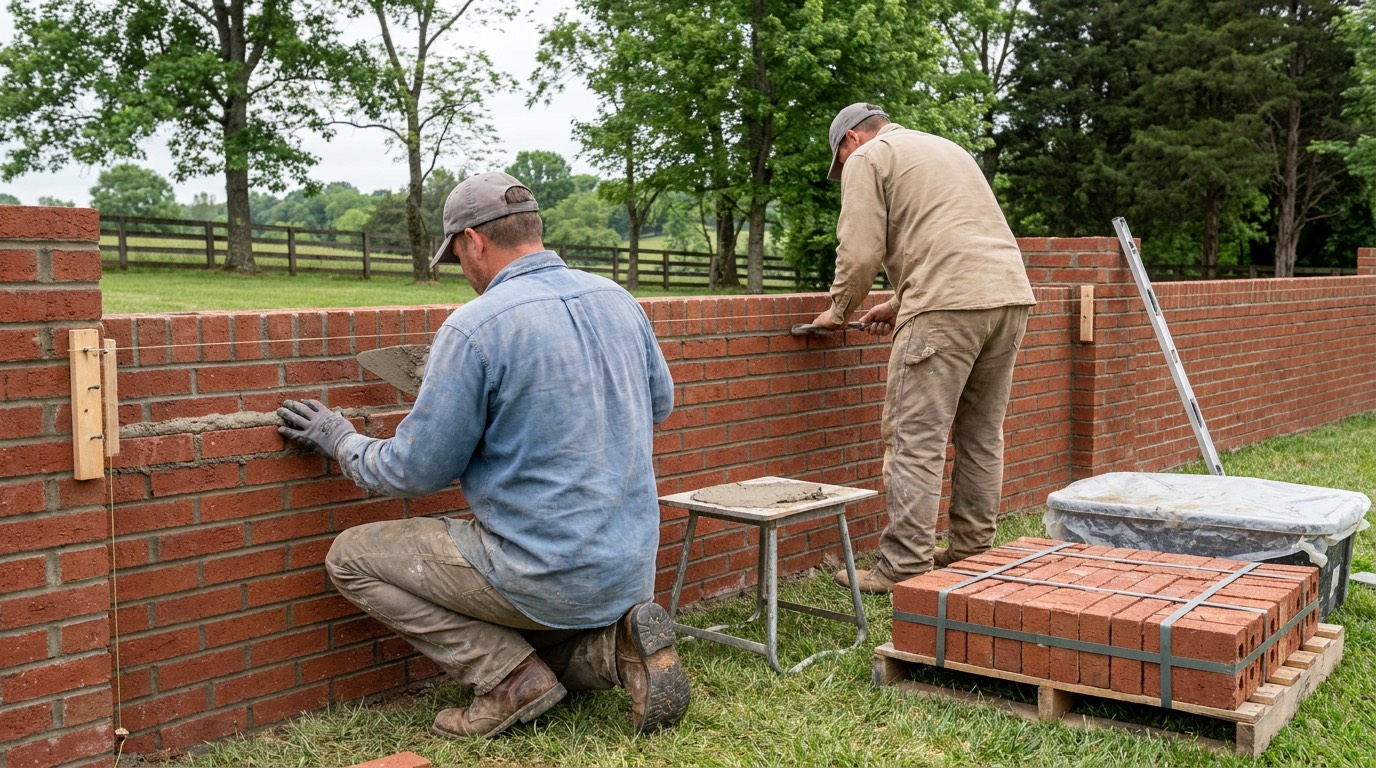 Hiring
What Belongs in a Masonry Quote Around Murfreesboro
A masonry quote is really a specification, and the price is only the last line of it. When the specification runs one sentence long, there is nothing there to compare.
ReadGetting a Chimney Ready Before the First Hard Freeze
The deadline for chimney work here is the first sustained freeze, not the first fire. Everything on this list is about one thing: how much water is inside the masonry when the temperature drops.
ReadChecking Masonry After a Tornado: Safety, Signs, Records
Tornado damage to masonry is different from ordinary storm damage. It moves things. This is what to check, what to keep your distance from, and what to photograph before anyone starts cleaning up.
ReadStraight answer on your wall.
Call, or send the form and we will get you a written price.