Restoring Civil War Era Brick in and Around Murfreesboro
Brick laid in Rutherford County before and around the 1860s behaves nothing like brick from a modern kiln. Treating it with modern materials is how a great deal of irreplaceable fabric has been lost.
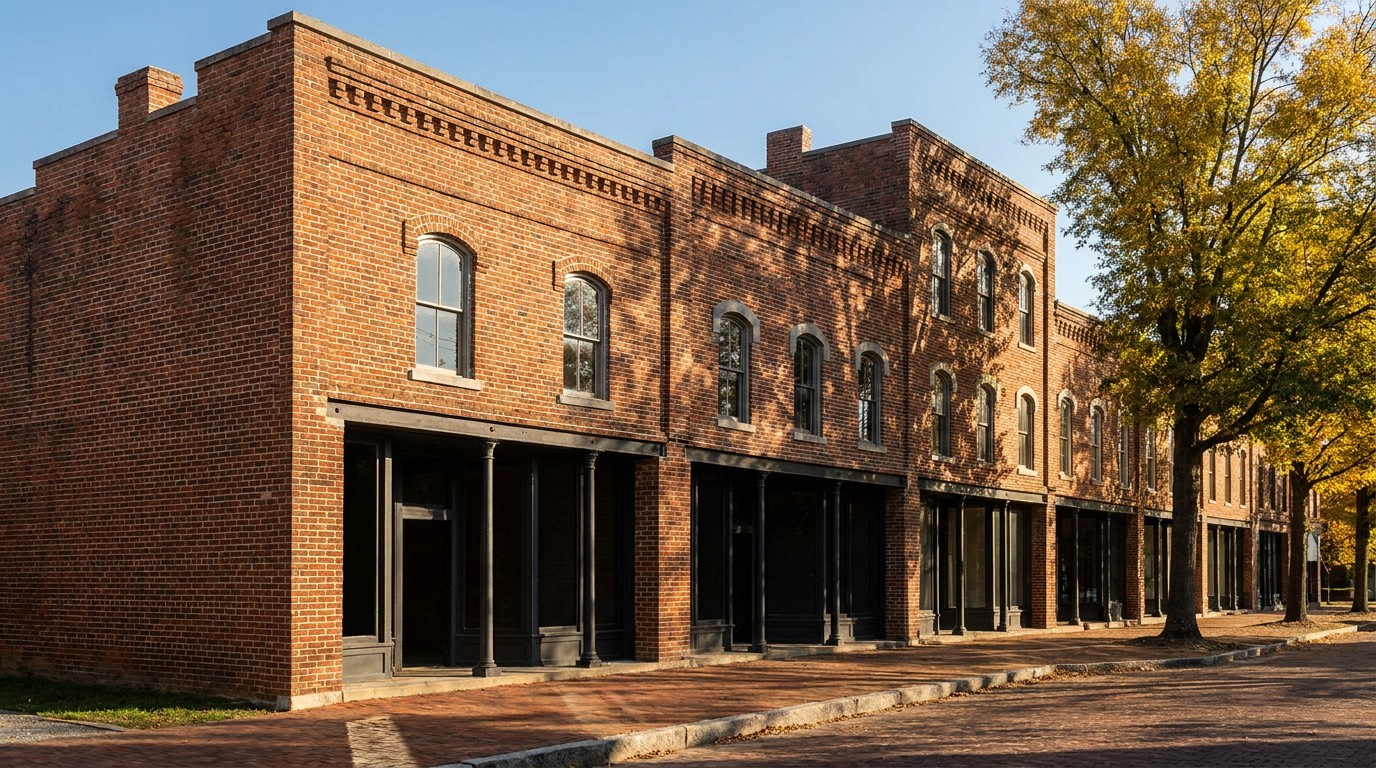
The brick itself is a different material
Nineteenth century brick around Murfreesboro was made from local clay, often close to where it was used, and fired in small kilns with uneven heat. The result is a unit that varies in color, size and hardness from one brick to the next, sometimes dramatically within a single wall.
It is also soft by modern standards and far more absorbent. A brick from a nearby clamp kiln in the 1850s might take on several times the water of a modern facing brick. That is not a defect. It is what the material is, and the wall system was designed around it.
That system depended on the mortar. Lime mortar was soft, flexible and permeable, and it let a wall move slightly and dry out through the joints rather than through the brick faces.
Sacrificial mortar and why it matters here
The governing principle in historic masonry is that the mortar must be weaker than the brick. Mortar is the sacrificial element. It is meant to take the wear, absorb the movement and eventually be replaced, while the brick stays put for centuries.
Modern portland cement mortar reverses that relationship. It is much harder and much less permeable than 1860s brick. Point a soft historic wall with a hard modern mix and the wall can no longer move or breathe through its joints, so stress and moisture go into the brick faces instead.
In Middle Tennessee, freeze thaw does the rest. Water that cannot leave through the joints sits in the brick, freezes and blows the faces off. Walls repointed with hard mortar in the 1970s and 1980s are still failing around here for exactly this reason, and the mortar is usually in better shape than the brick beside it.
Want a price for your own wall?
Four quick questions and we come back with a written quote. Or call (772) 251-6654 if that is faster.
Request a quote
Four questions, about a minute. We'll call you back.
Reversibility is the standard to hold work to
Preservation practice asks a simple question of any intervention. If this turns out to be wrong, can it be undone without harming what was there before?
Repointing with a compatible lime based mortar passes that test, because it can be raked out again later. Coating a wall in cement parging does not. Neither does a film forming sealer, an epoxy consolidant or paint, all of which are effectively permanent on porous historic brick.
The National Park Service publishes Preservation Briefs on historic masonry, including Brief 2 on repointing, and reversibility runs through the series. You do not have to be applying for anything to use that thinking. It keeps options open for whoever owns the building next.
- Prefer the gentlest treatment that solves the actual problem
- Repair rather than replace wherever a unit can be saved
- Avoid anything that cannot be removed later without damage
- Fix the water source before treating the symptom
- Document what was done, where, and with what materials
Matching is a craft problem, not a catalog problem
There is no order form for 1860s Murfreesboro brick. Matching means working with what exists, and it involves four separate things that all have to line up.
Unit size comes first, because historic brick is frequently a different height and length than modern standard, and a mismatched unit throws off every course around it. Then color range, which is a range rather than a single shade on hand made brick. Then texture and face character. Then the mortar itself, which is where most patches give themselves away.
Mortar color comes mostly from the sand. Matching a historic joint means matching the aggregate as well as the binder, and then matching the joint profile and width. A test panel in an inconspicuous spot, left to cure and viewed in daylight, is worth more than any amount of discussion.
- Unit dimensions, which often differ from modern standard sizes
- Color range across the blend rather than a single target shade
- Face texture, including hand molded irregularity
- Mortar sand, binder, joint width and joint profile
- A cured test panel reviewed outdoors before full scale work
The mistakes that have done the most damage locally
Most loss on historic brick here has come from well intentioned maintenance rather than neglect. Neglect is slow. Aggressive cleaning is immediate.
Abrasive blasting is the worst of them. It strips the fired skin off soft brick in seconds and leaves an open, absorbent surface that then spalls through the first few winters. High pressure washing does the same thing more slowly. Acid cleaners on soft brick etch the face and can drive salts into the wall, which then bloom back out as efflorescence for years.
- Sandblasting or any abrasive cleaning of soft historic brick
- High pressure washing, which removes the fired face and blows out lime joints
- Strong acid cleaners used without testing or thorough pre wetting
- Repointing with hard portland cement mortar
- Latex paint or film forming sealers that trap moisture inside the wall
- Modern brick used as infill where it neither matches nor behaves the same
Sourcing, salvage and a slower schedule
Historic work runs on a different clock. Reclaimed brick has to be found, sorted and cleaned of old mortar, and quantities are never guaranteed. Regional salvage yards are the usual source, and lead time is measured in weeks rather than days.
Salvaging from the building itself is often the better answer. Units taken from a rear elevation, an interior partition or a spot hidden by a later addition are a perfect match by definition, and modern brick goes into the concealed location instead. It costs labor and it is worth it on a visible facade.
Cold weather compresses the calendar further, since lime based mortars are more sensitive to freezing than modern mixes. That pushes historic pointing work toward the milder stretches of spring and fall, which is worth knowing before you plan a project for January.
Who to bring in before anything starts
If the building sits in a locally designated district or carries any historic designation, review requirements may apply to exterior work. Do not take a contractor's word for what is allowed, and do not take mine. Confirm directly with the City of Murfreesboro or Rutherford County, and with any commission that has jurisdiction over the property.
On the trade side, ask specifically about historic experience rather than general masonry experience. The relevant questions are what mortar mix they propose and why, how they intend to remove the old mortar without damaging brick arrises, and whether they will build a sample panel first.
The wider area gives this work its context. Stones River National Battlefield, the older streets off the square, and farmhouses scattered through the county all hold nineteenth century brick. Once a wall of it is lost to a bad cleaning or a hard repointing, no repair puts it back.
Related questions
Can I pressure wash historic brick if I keep the pressure low?
Low pressure with plain water and a soft brush is sometimes acceptable, and the margin is thinner than people expect. This brick drinks water. A historic wall around the Murfreesboro square stays saturated for days after a wash, and doing that in late fall hands a Tennessee winter a soaked wall to work on. Keep the job in the warm half of the year. Test a hidden area first, use the gentlest method that does anything at all, and stop the moment the fired face starts coming away, because that damage is permanent.
Should painted historic brick be stripped back?
Not automatically. Stripping can pull the face off soft brick and is often more damaging than leaving the paint alone. If the paint is trapping moisture and causing visible deterioration, removal may be justified using the gentlest chemical method, tested first. Otherwise repainting with a breathable coating is frequently the lower risk choice.
What mortar should be used on 1800s brick?
Something softer and more permeable than the brick, which in practice means a lime rich mix rather than a modern high cement one. You can see why for yourself on the older streets off the square in Murfreesboro. Where a wall was repointed with hard modern mortar, the joints now stand proud and the brick faces on either side have crumbled back, because the wall has to move somewhere and the softer material is what gives. Proportions depend on the existing mortar and the exposure, and a historic mason should analyze what is there before mixing. The principle holds even when the recipe changes.
Where does matching brick come from?
Three places, in rough order of preference. Salvage from a hidden part of the same building, reclaimed brick from regional salvage yards, and finally a modern unit selected to blend as closely as possible. The first gives the best match and the third is sometimes the only option on a large area.
Is historic restoration more expensive than ordinary repointing?
Generally yes, often significantly. The mortar removal is done by hand rather than with a grinder, the mortar is custom mixed, matching takes time, and the pace is deliberately slow to protect the brick. You are paying for care and for the fact that mistakes on this material cannot be undone.
Does my house have to be in a district for any of this to matter?
No. The material behaves the same way regardless of designation. A farmhouse out toward Christiana or Woodbury with soft 1800s brick has the same compatibility requirements as a building on the square. Designation changes the paperwork, not the physics of the wall.
More guides
All guides →Cleaning Brick Without Damaging It
Dirt is temporary. A brick face burned open by the wrong cleaner is not. Here is how to identify what you have, match the method to the stain, and test before you commit.
Read Seasonal
Cold Weather Masonry: Where the Real Limits Are
Masonry in Middle Tennessee has a real winter slowdown, and any contractor who says otherwise is skipping something. Here is where the limits are and what still gets built.
ReadCracked Brick Veneer or a Structural Crack? How to Tell
Not every crack in a brick wall means the house is moving. Here is how to read one, which patterns are cosmetic, and the point where guessing should stop.
ReadCrumbling Mortar: How to Tell When Brick Needs Repointing
Mortar is designed to be the part that gives up first. The useful question is not whether yours is deteriorating, but how deep it has gone and whether it is time to act.
ReadWhite Residue on Brick: Reading Efflorescence Before You Scrub It
Efflorescence is not a stain sitting on your brick. It came out of the wall, dissolved in water, and the pattern it leaves is a map of where that water is getting in.
ReadStraight answer on your wall.
Call, or send the form and we will get you a written price.