Retaining Wall Failure Signs: Lean, Bulge, Separation and Drainage
A retaining wall gives you months of warning before it goes. Four signs to read, in the order they usually show up on Middle Tennessee clay.
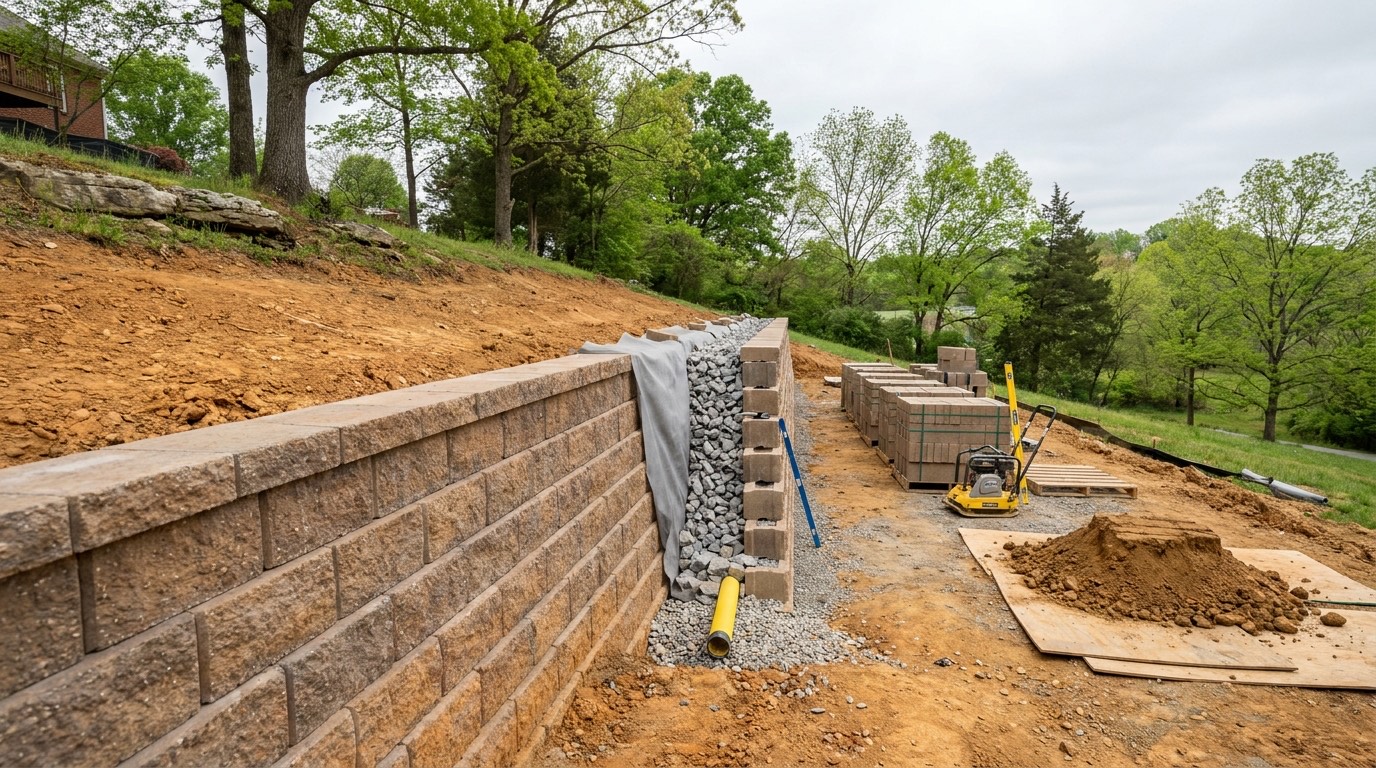
The wall is working every second of every day
A retaining wall has one job and it never gets a break. Every hour it is holding back a slope that would rather be flat, and after a heavy spring rain in Rutherford County it is holding back that slope plus the weight of the water soaked into it.
The good news is that walls almost never fail without warning. They tell you for months, sometimes years. The problem is that the warnings are slow enough that you stop seeing them, because you walk past that wall every day and today looks exactly like yesterday. Four things are worth learning to spot: lean, bulge, separation, and drainage that has quit.
Lean, and how to measure it without guessing
Some walls are built with a deliberate backward tilt into the hill, called batter, and on segmental block walls it comes from the way the units set back on each other. So a wall that tips slightly back toward the slope may be doing exactly what it was designed to do. A wall tipping out toward you is not.
Measure it instead of squinting at it. Hold a four foot level vertically against the face and see how far the bottom has to come out for the bubble to center. Do that at three or four points along the run and write the numbers down with a date. Repeat after the next wet stretch. A number that holds steady across seasons is history. A number that grows is a live problem, and the rate matters more than the reading.
Want a price for your own wall?
Four quick questions and we come back with a written quote. Or call (772) 251-6654 if that is faster.
Request a quote
Four questions, about a minute. We'll call you back.
A bulge in the middle of the run
A bulge is worse news than a lean, and homeowners usually notice it later. It shows up as a belly in the middle of the wall, both in height and along its length, while the ends stay put.
Stretch a string line tight between the two ends of the wall and stand back. Anything pushing past that line is deflection, and deflection means the wall is bending under a load it was not built to carry. On mortared block and stone you will often see it before you feel it, because bending opens cracks in the joints along the belly. On dry laid or segmental block walls the units start to look out of line and gaps open at the vertical seams. A bulging wall is closer to failure than a leaning wall of the same age, because the middle has nothing holding it and the ends are already doing all the work.
Things pulling apart at the ends and corners
Look at where the wall meets something else. Corners, returns into the bank, step ups along a sloped run, the joint against a set of stairs, the point where the wall dies into a driveway or a house corner. Separation shows up at those transitions first because that is where two things with different amounts of soil behind them meet.
A vertical crack opening at a corner, a step that has dropped out of line with its neighbor, a cap stone that has slid or now sits proud of the one beside it, or a gap you can slide a finger into where the wall meets a stair cheek. Those are all the same message. One part of the wall is moving and the other part is not going with it.
- Vertical cracks widening at corners and returns
- Cap stones sliding, tipping or opening gaps between them
- Steps in a tiered wall dropping out of alignment
- A finger width gap where the wall meets stairs, a drive or a house corner
- Mortar joints crushed or spalling at the bottom courses
The drainage has quit, which is usually the actual cause
Nearly every failed wall we look at around Murfreesboro failed for the same reason. Water got behind it and had no way out. Middle Tennessee clay swells when it takes on water and it does not drain freely, so a wall with a blocked or missing drain is holding back saturated soil that weighs far more than the dirt the builder had in mind.
Go look at the wall during a rain, not after it. Weeps or a drain outlet that stay dry while the ground above is soaked mean the water is going somewhere else, and behind the wall is the only place left. Water seeping through the face rather than out the bottom says the same thing. Dark staining, white efflorescence bleeding down the front, moss on the lower courses and mud washing out through the joints are all evidence that water is moving through the wall instead of around it.
Read the ground, not just the masonry
Half the diagnosis is above the wall and behind it. If the top of the wall has moved out, the soil it was holding has to have moved with it, and that shows on the surface.
Walk the ground above the run and look for a crack in the lawn or the mulch bed roughly parallel to the wall, a fence line that has started tipping, a patio or walkway settling at the edge nearest the drop, or a soft depression that was flat last year. Downspouts discharging straight onto the backfill, an irrigation line running along the top, or a neighbor's regraded yard now sending runoff your way are all loads nobody accounted for. Fixing where the water lands is often cheaper than anything done to the masonry.
What to watch and when to stay off it
Plenty of walls can be monitored honestly. A low garden wall under about three feet with a stable lean, no bulge and dry drainage is usually a photograph and a date, checked twice a year. Say that out loud to any contractor who tells you every crack is an emergency.
Stop using the area and get eyes on it when a wall over about four feet is leaning and the lean is growing, when there is a visible belly, when soil or mud is coming through the face, when the ground above has dropped, or when the wall holds up a driveway, a pool deck, a structure or anything people stand on. Walls of that size generally need engineering, and the height that triggers it is set by the county, so confirm the current requirement with the Rutherford County building department rather than trusting a rule of thumb from a forum.
Related questions
My block wall leans back into the hill. Is that a problem?
Usually not. Segmental block walls are built with a deliberate setback, so each course sits slightly behind the one below and the finished face tilts into the slope. That is by design. The tilt that matters is the one going the other way, out toward the low side, and any tilt that is increasing.
How do I know if the lean is getting worse?
Take measurements rather than impressions. Hold a level vertically at several marked points and record the gap at the base, along with the date and a photo from a fixed spot. Repeat each spring and fall. Middle Tennessee cycles between drought and heavy rain, so a full year of readings tells you far more than one visit.
Water comes through the face of my wall. Should I seal it?
No. Sealing the face leaves the water behind the wall, where it goes on pushing. Winter makes that worse here, because Middle Tennessee sits near the freezing line rather than under it. A saturated wall thaws by afternoon and freezes again overnight, over and over, and block or stone splits from the inside. Water at the face means the drainage behind the wall quit. That is the repair.
Can a leaning wall be pushed back instead of rebuilt?
Rarely, and not on a mortared wall. Once mortar joints have cracked and the soil behind has moved in to fill the space, there is nothing to push back into. Some dry laid and segmental walls can be taken down and reset course by course, which is really a rebuild using the existing units.
How urgent is a wall that has been leaning for years?
The rate is what counts, not the age. A wall that moved once, settled and has held the same position through several wet springs is behaving differently from one moving a little each season. That is exactly why the dated measurements are worth taking. Without them you are comparing today against memory.
Does my wall need an engineer?
Height and what sits on top of it decide that. Taller walls, tiered walls, and any wall holding up a driveway, a structure or a loaded slope generally need a design. The height that triggers a permit and stamped drawings is set by the jurisdiction, so ask the Rutherford County building department if the wall is here, and Williamson County or the City of Brentwood if it is up that way. Same wall, two counters, and the answers are not always identical.
More guides
All guides → Local guide
Do You Need a Permit for Masonry Work in Rutherford County?
Permits follow structure, not brickwork. Here is how masonry jobs usually get sorted around Rutherford County, and why the only answer that counts comes from the office covering your address.
ReadShould You Seal Your Brick? Usually Not, and Here Is Why
Somebody offered to seal your brick and it sounded like cheap insurance. On most Murfreesboro houses it is the wrong move, and the reason is what winter does to trapped water.
ReadSpalling Brick: Why the Face Pops Off and Spreads
Spalled brick is the face of the unit flaking or popping away, leaving a rough lighter interior exposed. Once it starts on a Middle Tennessee wall it tends to get worse each winter, and the reason is simple physics.
Read Seasonal
After a Spring Storm: What to Check on Brick and Stone
The damage that matters after a spring storm is rarely the kind you can see from the driveway. It is water that got somewhere it does not normally go.
ReadStair-Step Cracks in Brick: Reading What the Wall Is Telling You
A diagonal crack that steps through the mortar joints is the wall reporting movement below it. The pattern, the direction and the width all mean something specific.
ReadStraight answer on your wall.
Call, or send the form and we will get you a written price.